
Flicker in a glance
Line Lyhne
09.30.2026-10.24.2026
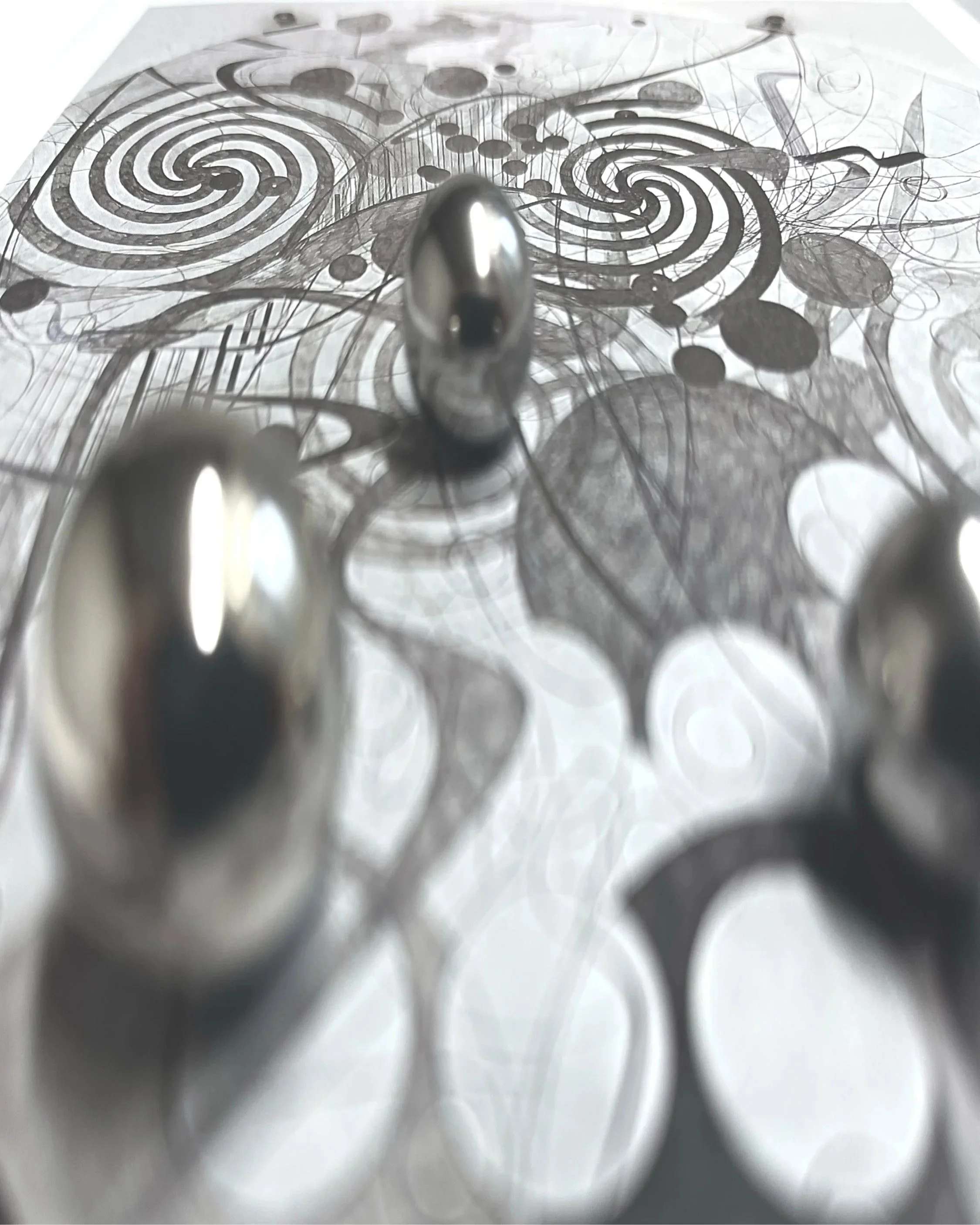
In her exhibition, Flicker in a glance, Danish artist Line Lyhne presents a new series of drawings alongside a large-scale floor sculpture that consider the relationship between surface and ground and the poetics of chance.
Moving through the exhibition, carefully stepping between the materials that make up the sculpture, I, too, overflow, evokes a sense of walking across the spatial plane of Lyhne’s drawings. Dispersed across the ground are coins, spoons, magnets, keys and small spheres. A collection of what might accrue in the bottom of a bag or a studio drawer. Their composition appears casual, an informal assembly of objects in an abstract conversation, repeating and diverging forms and clusters. Diffuse and site responsive, the sculpture resists a fixed identity, turning the gallery floor into a sculptural surface, or a pictorial ground for its idiosyncratic arrangement.
These objects are echoed in the drawings, as Lyhne makes use of them by scattering, then tracing some of them across the picture plane. The process of throwing coins on the paper to determine the composition evokes the I Ching, an ancient Chinese divination practice, where coins are tossed and translated in a sequence of simple glyphs depending on how they land—heads or tails—and in what combination. The symbols are comprised of a system of short broken and unbroken lines, not dissimilar to the quality of the carefully repeating marks in many of these drawings. While the I Ching is not a direct reference for the artist, chance and what surfaces from the unconscious guides this new body of work. In some ways the drawings not only trace the contours of the coins but also suggest the movement of a coin falling through space, turning and flipping from a disc to a thin line and back again, a spiralling fractal.
Lyhne’s previous sculptural works’ have a clear relationship to time and labour, and here those concerns emerge more obliquely. The coin points directly at systems of value and capitalist exchange but, beyond its exchange-value, a coin is also an object of public intimacy. A small form that passes through countless hands, traverses a city, in and out of pockets, purses, homes and businesses. This calls to mind the spoons in Lyhne’s sculpture, their handles removed, estranged from their function in a way that accentuates the fact that this is an object for the mouth, a form that enters the private space of the tongue. Spoons and coins occupy a similar material ubiquity. Both are forms that circulate, are shared and used by many, whether that is the public at large or the smaller public of a household and its guests.
As one’s gaze bounces between the floor and the wall, both planes expand. The drawings oscillate between diagrammatic fragments of architecture and what appears to be a choreography of movements across a surface. As we navigate the sculpture, our movement through space echoes the curves and flowing lines in the drawings. Guided by the objects plotted out on the floor, pathways like desire lines coax us through the gallery, moving between the vertical and horizontal planes, a poetics of line, spheres and spirals that endlessly scale and mirror one another through a shared logic of fragmentation, chance and repetition.
Text by Claire Greenshaw